STSA – Swiss Trading and Shipping Association


PRESS RELEASE


New National Association for the Swiss Commodity Industry

Geneva / Lugano / Zug, 1 October 2014 – Commodity trading houses active in Switzerland have established a new organization to represent their interests on a national level: the Swiss Trading and Shipping Association (STSA). STSA will consolidate three existing regional associations, the Geneva Trading and Shipping Association (GTSA), the Lugano Commodity Trading Association (LCTA) and the Zug Commodity Association (ZCA), each of which will be represented on STSA’s Executive Board.

“The commodity industry plays an important role in the Swiss economy, and by aligning our industry’s three centers – the Lake Geneva Region, Lugano and Zug – on a national level, we will be able to more clearly communicate with and effectively engage Swiss authorities, NGOs and the media,” said Stéphane Graber, who will serve as Secretary General the new STSA.

The new association will work to promote the positive contributions of the commodities industry in Switzerland, as well as generate understanding about how the merchants are upholding their roles as responsible corporate citizens. “The commodity trading industry is committed to transparency and ensuring there is an open dialogue involving all interested parties in Switzerland, from elected officials and regulators to NGOs and the media,” said STSA’s Secretary General. “The Swiss-based traders and shippers play an essential and historic role in the Swiss economy. Our national association is an effective way for these companies to participate in an open dialogue with the Swiss community”.

The Swiss Trading and Shipping Association will be headquartered in Geneva. STSA, through its three regional organizations GTSA, LCTA and ZCA, represents almost 150 diverse commodity companies involved at different stages of the commodity value chain, including 20 members with financing and legal background. The President of the STSA is David Fransen. According to official statistics, the Swiss commodity industry counts around 500 companies which contribute CHF 20bn (3.5%) to the country’s Gross National Product GDP. The number of jobs in the Swiss commodity industry is estimated to lie between 10’000 and 12’000.

For further questions:

Dr. Stéphane Graber
Secretary General STSA
O +41 22 715 29 90
E info@gtsa.ch

STSA – Swiss Trading and Shipping Association. 14 rue de Mont Blanc. 1201 Geneva. Switzerland.


FacebooktwitterlinkedinmailFacebooktwitterlinkedinmail

Get your interview pitch right

pitch imagesFamously, the elevator or interview pitch is that big chance you get to sell yourself in just one or two minutes.

Thinking about how to deliver your message in an effective way that goes straight to the heart of the matter can be a very useful and rewarding exercise. Whether you’re going for a job interview, or a client pitch, or just telling people what you do. This can be of great value to you. Here are a few principles to keep in mind.

SIMPLICITY

In my experience too many pitches get bogged down in overly complicated language. There have been times when entrepreneurs pitched to me and I had to stop them after a while because what they were saying wasn’t making any real sense though I always try in giving people the benefit of doubt and a chance to show what they can do. Therefore I tell them to cut out the unnecessary jargon and tell me things in a business-like yet simple way. You want to sound professional but there are ways to do this without boring people. Present you pitch to the receiver so they easily can remember you and your main attributes.

DO YOUR RESEARCH

Keeping it simple should not be an excuse for not doing your research. Even if your elevator pitch is supposed to be short and snappy, you don’t want to get caught out afterwards with a question you don’t know the answer to. Be prepared and know who you are pitching to. As well as ensuring you are ready for any questions you may be asked afterwards, this means you can tailor your pitch to suit the audience.

SELL WITH SUBTLETY

Remember that whilst an elevator pitch is a tool to sell your best aspects, it should not be over the top. All you want to do is generate enough interest to pique their interest. Explain the essence of your background and then subtlety highlight your uniqueness. This is basically your hook that will make or break the success of your elevator pitch. Some people don’t really think about the concept of an elevator pitch until the opportunity comes along. But if you can set aside half an hour at some point and just think about what you would include in your elevator pitch, it can have huge benefits. If nothing else, it will allow you to take a step away and think about what sets you apart from the the other candidates, and what sort of image you want to project.

FacebooktwitterlinkedinmailFacebooktwitterlinkedinmail

Which of These Mistakes Do You Make?

1406 mistakes pictureNo matter what you want to succeed at in life—your career, a hobby, your personal life—there are a few universal truths that can be applied to the pursuit of success, and a few mistakes that can be considered universal barriers to achieving it.

Avoid responsibility
The price of greatness is responsibility.” –Winston Churchill

One of the first things you will notice that successful people don’t have is a blaming or victim mentality. When things go wrong, what is your first response? Successful people won’t say, “I couldn’t succeed because of X, Y, and Z” or “It’s actually this person’s fault.” They’re much more likely to own a mistake rather than blame others for their failure or misfortune. I believe the key here is that by owning a mistake, we are more likely to learn from it and much less likely to repeat it.

Procrastinate
Procrastination is the bad habit of putting off until the day after tomorrow what should have been done the day before yesterday.” ~Napoleon Hill

Successful people tend to take action, regardless of whether it is the “perfect” time or not. When Gutenberg invented the printing press, the literacy rate was almost nonexistent—not exactly perfect market conditions for mass producing books. And no one knew they needed a “smart” phone until Apple invented one. Don’t wait for the perfect time to do something. Work hard and don’t give up—regardless of what might be going on around you. Success is very often the accumulation of many small achievements over a long period of time.

Follow the trends
Great things are not accomplished by those who yield to trends and fads and popular opinion”. –Jack Kerouac

Every day we produce 2.5 quintillion (1018) bytes of data. In that flood of information, it’s tempting to think that we have to jump at every new development, try every new thing. (We sometimes call it “shiny object syndrome.”) But jumping at every new thing will leave no time to develop the deep understanding that pursuing lifelong learning might. Focus your energies on understanding the root of what you hope to succeed at and ignore the rest. For example, if you hope to succeed in sales or marketing you might choose to study human psychology rather than the latest social media marketing schemes.

Try to go it alone
Life is not a solo act. It’s a huge collaboration, and we all need to assemble around us the people who care about us and support us.” –Tim Gunn

One of the most vital things successful people do is to surround themselves with other successful people. No man is an island, and having a network, a mastermind group, surround oneself with clever people can make all the difference between success and failure. This is true whether you hope to succeed at a personal goal like weight loss (studies show people lose more weight in a group than alone) or a business goal.

Lack of belief
Believe in yourself! Have faith in your abilities! Without a humble but reasonable confidence in your own powers you cannot be successful or happy.” –Norman Vincent Peale

This isn’t about positive affirmations or visualizing success, but rather, as Peale says, “a humble but reasonable confidence” that you can achieve what you set out to achieve. Think about it the other way round if you are skeptical; if you don’t believe that you can succeed, why would you even try? You must cultivate a strong belief in yourself even in the face of setbacks or adversities if you hope to ultimately be successful.

Be happy with what you have

“Be happy with what you have and are, be generous with both, and you won’t have to hunt for happiness. ” – William E. Gladstone

Avoiding thes above mistakes will help you succeed at work or a single goal or task, but to be truly successful, we also need to be happy. The sixth mistake I see unsuccessful people make is not seeking a health balance between work that fulfills, family life, friends, and health. Only when you make happiness and balance a goal can you truly succeed in any other area of your life.

FacebooktwitterlinkedinmailFacebooktwitterlinkedinmail

Hard interview question – be prepared!

The most difficult questions you’ll encounter in a job interview are the commonly asked behavioral or situational interview questions. The interviewer uses a probing style to ask questions seeking very specific examples. They often start out with, “Tell me about a time …“, or “Describe …”, or “Give me an example ...” The interviewer is looking for details of your past abilities and specific work performance. He or she rates each response to determine how well you reacted to these situations in the past, and to predict your future performance with their company. These situational questions are thought-provoking and you should consider your answers carefully. The interviewer likely will take notes on each answer. Your answer must contain specifics: specific details, specific illustrations, about a specific work situation.

You don’t want to make a fatal error by offering something vague and poorly phrased that might hurt your candidacy. You’re unlikely to know in advance who will use this format, so be prepared with concise, detailed examples of your experience that will impress any interviewer with your capabilities. Expect to be asked situational interview questions at some point in your job search. A Human Resource Manager at a Fortune 500 company explained it this way, “We now instruct ALL of our managers and HR people to ask only work-related questions that require specific examples. Every interviewee gets the same set of questions designed to evaluate their skills to perform that specific job, based on the examples they give us.”

Advanced preparation is mandatory

Be very clear in describing the situation – where it happened, when, who was involved, what your actions were and what was the positive result you achieved.

Create a few work examples about your ability to work well with others, show your leadership skills, show you can do the technical aspects of your job, demonstrate good communication skills, etc.

Demonstrate Your Results

Offer a specific example of how you’ve successfully operated in the past. Employers want assurances you’ll be able to do the job. Explanations that include examples of how you solved a problem, saved money, or added to the bottom line. Develop specific examples to illustrate the positive results you’ve achieved, whether it’s reorganizing the filing system or trimming production costs through a process change. Examples can also include the results of volunteer jobs and committee activities outside the office that are work related, i.e. actions as your professional association president.

Use descriptive words that paint a picture of how well you’ve performed the task in the past. For example: “I initiated and assembled a task force to address the problem of declining sales revenues in our Spokane branch. The group recommended changes in our marketing approach which resulted in a 15% increase in sales the first six months after we implemented the new changes.”

In the book “60 Seconds & You’re Hired!” by Robin Ryan, you’ll find answers to many of the hardest and trickiest questions interviewers may ask.


FacebooktwitterlinkedinmailFacebooktwitterlinkedinmail

Avoid Wasting Time

waste time1. Explore more; commit less
One paradox of essentialism is that essentialists exploremore than their nonessentialist counterparts — they’re just systematic about it. Essentialists are incredibly selective about what they commit to. In the interim period, they can be curious about lots and lots of things. They just don’t go deep until they find something that’s a total 10-out-of-10 ‘Yes! This is the thing I should be doing.’ Think of Steve Jobs and Jony Ive saint day after day, “This might sound crazy but…” And most of the ideas were crazy until, as Jony put it, eventually an idea was so great it took the air out of the room.

2. Negotiate the nonessentials
For a lot of people it is laughable to imagine saying “No!” to a senior leader. They worry, for good reason, that such a blunt response will immediately be a career limiting move. However, when we get caught between the false dichotomy of “either I have to say yes to everything or I will be seen as insubordinate” leads a lot of people to avoid the conversation about what they should really be focused on. When people believe that nonessentials are nonnegotiable they lose a lot of power in that very moment.

3. Conduct a career offsite
 As someone once said to me, we spend more time planning our vacation than planning our careers. We can apply the practice of a quarterly offsite to our own lives and careers by taking a few hours to think about the bigger picture questions: “If I can only achieve three things over the next three months what would they be?” and “Where do I want to be five years from now?” When we only react to the latest email we become rudderless; blown about by every wind of corporate change.

4. Come back to your purpose
My friend and ocean advocate, Lewis Pugh, has designed an extraordinary career around his professional purpose: to create National Parks in the Oceans. His clarity of purpose enables him to achieve the (almost) impossible. Among other things he swims in the most extreme water conditions imaginable. In one recent TED talk he describes swimming in the North Pole in temperatures of minus 1.7 degrees (see it here). He says, “The most powerful form of self-belief comes from believing in something greater than you. Because when you’ve got purpose, everything becomes possible.” So when you are exhausted or getting pulled in a million directions come back to your purpose.

5. Give up the idea that success means pleasing everyone
Thinking that you can say “yes” and keep everyone happy is a false premise. When you try and say yes to everyone, is everyone happy? No! You will make a millimeter progress in a million directions, which will frustrate you and everyone else. When you say push back you may be sacrificing an ounce of popularity in the moment, but you’re trading up for a longer-term respect.

6. Celebrate the reality of tradeoffs. Instead of asking, “How can I make it all work?” Ask, “What are the tradeoffs I want to make?” Make them deliberately and strategically. Don’t try to straddle every request. As Michael Porter has written, “Strategy is about making choices, trade-offs. It’s about deliberately choosing to be different.”
In the end, it is this idea of choosing to be different that can be so powerful. Designing a career of contribution is less about adding layers of activity like we do in an oil painting. Instead, it is about becoming more of who we are already are by chiseling away those things that don’t feel right.

FacebooktwitterlinkedinmailFacebooktwitterlinkedinmail

Why saying ‘No’ is important

1405 No
When I started my recruitment business, I chased every opportunity that came my way. My company was brand new and I needed clients. To grow my business, I said yes to everything.

I was so busy chasing down every opportunity that I became unfocused. So I took a step back and started to measure what events and activities actually made my business grow. I changed my business model and agreed only to the opportunities that helped me scale my business and I learned to say no to everything else.

So why is one tiny word so hard for most of us to say? It’s because deep down inside, we all want to be liked so we worry that saying “no” will change the way others view us. This can be especially difficult if you’re a people pleaser. But before you take on any more responsibilities, here are some guidelines to consider.

Be proactive. When you say yes to every opportunity, your actions may become reactive and it can bleed in to other areas of your business. You may become oversensitive to pressure-filled situations and lose focus. Reactive entrepreneurs often become slaves to the demands of clients, employees, investors and partners. Instead of working toward your long-term goals, you could find yourself chasing after every dollar — and undermine your future earnings in the process.

Develop criteria for events. Make a list of objectives and goals for yourself and your business. When you decide to attend an event or conference, make sure you will benefit in some way by attending. In other words, measure the opportunity cost of your time commitment against the potential ROI.

Negotiate for better opportunities. If someone invites you to attend an event, volunteer to speak at the event as well. Negotiate a date when the majority of participants will be in attendance. Reach for better opportunities whenever possible.

Don’t give away what you can sell. It’s easy to develop a reputation of desperation. If you say yes every time someone asks you to share your advice, you erode the value of your expertise. Your time is valuable. Any time you spend away from your business has an opportunity cost. Don’t make a habit of doling out advice or other free information; it’s your value as an entrepreneur.

 Practice the polite decline. When you say no to things that won’t help you grow your business or future relationships, you say yes to yourself. You make yourself the priority and you stay true to the direction of your business. If you’re not quite ready to say no in your professional relationships, practice with your friends and acquaintances whenever possible.

Choose clients selectively. If you’ve ever had a difficult client or a customer who does not give you enough information and feedback, you know what a headache it can be. It drains you of time, energy and resources. Particularly difficult clients can be an emotional nightmare and push you to your limit. Look for red flags when you first meet potential customers. If you sense there will be personality conflicts or the scope of the project may grow beyond the initial request, don’t be afraid to say no or recommend someone else.

Saying ‘no’ will make you a better entrepreneur. It requires some courage to turn down opportunities. Especially in the beginning, a lot of new business owners worry that they’ll never get another client or close another deal. But don’t be afraid to let one opportunity go if it doesn’t feel right. If you keep a positive outlook, you’ll find that another one will come around and take its place in due time.


FacebooktwitterlinkedinmailFacebooktwitterlinkedinmail

Attitude – Competency – Mindset – the winning combination

One of the things that great companies do is they hire the best people. These successful companies aren’t afraid to recruit the best candidates from other organizations or pull talented people from other industries. There are three attributes that are most important to an organization when hiring: attitude, competency and mindset. 

Attitude. An employee has a passion for the organization and what it is trying to accomplish and is excited about being a part of the organization.

Competency. An employee has the right skills and capabilities to do his or her job, or has the ability to learn the right skills.

Mindset. An employee understands the value of collaborating with peers and comes to work every day looking for ways to improve the performance of the company and increasing the impact he or she can have.

Related: Want to Avoid a Hiring Crisis? Follow These 4 Steps.

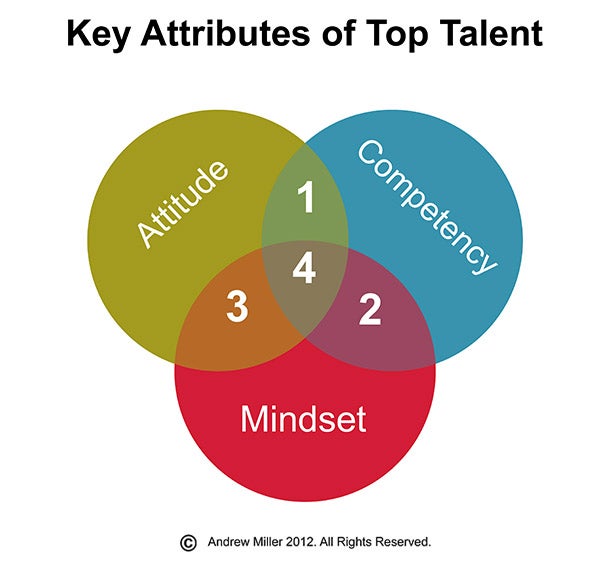
See the visual below of my ACM Model that shows the perfect intersection of those three attributes:

The 3 Attributes to Look for in Top Talent

Here are the issues if your candidate doesn’t fall into the sweet spot in the center:

1. Good attitude and strong level of competence, but the wrong mindset. The candidate will be focused on his or her own goals and accomplishments and will not be willing to collaborate to improve the performance of the company unless it benefits them personally.

2. Right competency and mindset, but the wrong attitude. The talent will leave because they have no loyalty for the organization or connection to what it is trying to accomplish.

3. Preferred attitude and mindset, but a low level of competency. You will suffer productivity loss. Even though the employee might be a great person and have great energy and passion for the organization, they don’t add any value because they don’t have, and can’t learn, the required skills.

Related: 5 Attributes to Look for in High-Performing Employees

4. The right mix of attitude, competency and mindset. With this mix, you achieve profit maximization. This happens because every employee you hire is adding value to the organization on a consistent basis.

You’ll notice that I didn’t mention experience, and that is for good reason. When you find a great talent who is passionate about what your organization is doing, experience doesn’t matter. Great people can decipher what they need to learn in order to be successful. Twenty five years in the same industry or with the same company is not necessarily a good thing. It’s much harder to unlearn what you know then learn what you need to know.

Even if you don’t have a specific role in mind, when you find someone who has all three attributes, hire them. Find a role for them. You can create a new role if you need to because they will contribute tremendous value for your organization.

However, if any one of the three attributes is missing, employees will not last very long with your organization. You will be hiring the wrong people for the wrong reasons. Integrate the search for these three attributes into your hiring process and you will attract better people and make better hiring decisions.

If you want to know if your hiring efforts are yielding the right results, ask yourself this question, “Are we the company that people line up to work for or rush out the door to leave?”


FacebooktwitterlinkedinmailFacebooktwitterlinkedinmail

4 Tips to Ace a Phone Interview


PhoneInterviews


Increasingly, employers are phone-screening job candidates before inviting them for an on-site interview.

Maybe this is good news. Phone interviews are easier, right? You can have a bunch of cheat sheets in front of you — your resume, sample answers to common interview questions, and key facts about the company. You can wear your pajamas — heck, you can even stay in bed while you chat!

Well, not exactly. In fact, the number one mistake job candidates make on phone interviews is sounding tired, bored, or disengaged. Good luck avoiding this if you’re reading from a script or tucked away in bed!

Without visual cues, interviewers are paying extra close attention to the content of your answers and anything else they can glean from your voice. So, lackluster answers or low energy could be read as lack of interest — and can keep you from getting in the door for that next interview.

So, how can you maximize what you convey with your voice? Follow these simple steps.

1. Do Some Power Poses

A few minutes before the interview, prep by doing some “power poses.” Research shows that standing with your legs shoulder-length apart with your hands on your hips and your chest out for just two minutes raises your testosterone levels, lowers cortisol, and makes you sound more confident. You might feel silly, but at the very least, it’ll help calm some nerves. Definitely a good thing!

2. Stand Like a Speaker

Like anyone who’s speaking or telling a story, you want to sound dynamic and engaged. And slouching in a chair is just not going to help with this. Instead, try positioning yourself like a speaker: A good setup is having some relevant materials on a desk or table in front of you as you stand. (And by relevant, I mean bulleted talking points, not prepared documents — remember, you want to sound natural and energetic!)

3. Don’t Forget to Smile

And feel free to laugh! Yes, this is an interview for a job, but ideally it’s also a conversation between two mutually interested parties. Don’t make the mistake of sounding overly serious or timid. Your skills and qualifications got you the interview, but it’s your personality and commitment that wins over hiring managers. The fact is, no matter how standardized companies try to make their interview processes, being friendly and getting the interviewerexcited about working with you will have a huge effect on whether you get invited to the on-site interview. So, smile! Even if they can’t see it, your voice will sound more cheerful.

As a final note, treat this as you would an on-site interview, and do the proper logistical preparation. Make sure you have a quiet place to conduct the interview, and check to see if you have good phone signal (better yet, use a landline). Confirm the date and time with your interviewers a day before, along with a line letting them know you’re looking forward to it. Because, you are! Especially now that you’re ready to blow them away with your energy and drive.

4. Thank you note

Follow up a few hours but not later than one day after the call. Receite some of the interesting points you most appreciated, add any information that you thought could still be useful, and obviously add any documents, links etc that you said you would share with them.  Here you can also confirm the nest steps and show your negotiation skills first hand.

FacebooktwitterlinkedinmailFacebooktwitterlinkedinmail

Things A Resume Won’t Tell You

The standard resume format doesn’t say Jack about how the job-seeker got into the field s/he’s in. We see that he or she went from Company A to Company B, but we don’t get the answer to the question “why” at each juncture. That’s the most important element!  We want to see the logical through-line in the resume, and that’s exactly what’s left out.

Turning Corners

The traditional resume doesn’t tell a hiring manager why the job-seeker left each job to go to the next one. Did you see the CEO speak at a conference, and get excited about his mission? The resume has nothing to say about job transitions.

Mission Accomplished?

The typical resume doesn’t say a word about what the mission you took on at each new job. We don’t know the mission, so how would we know whether it was accomplished?

What Would You Be Like to Work With?

The by-the-book resume format doesn’t give us any clues to what you’re like to work with, or what your working (or even writing) style might be. Are you sprightly, sober, analytical, chirpy or theatrical? The standard resume format all but wipes out any traces of a job-seeker’s personality and style.

How Will You Approach the Role?

Hiring managers would love to know how you approach problems and take ownership over your job and career. They want to know how you’ve grown as a businessperson over the years. The standard format, laden with tedious, factual bullets, tells us “Here’s what the job required – which is to say, the tasks that anyone in the job would have performed” versus “Here’s what I brought to the job, because of who I am.”

What Were the Stakes for Your Past Projects?

Hiring managers want to know the conditions on the ground when you took each past job. When we see an employer name like GGG International on a resume, we don’t know whether that company is large, small, struggling, booming, or even still in existence. The standard resume format throws context (the most important element!) out the window.

You Say You’ve Got Skills – But Do You Know When (and How) to Use Them?

With its emphasis on Skills, the standard resume format doesn’t tell a hiring manager how well you can pull those abstract Skills (negotiation, communication, or administration, e.g.) off the shelf and use them when the situation requires it. When a job-seeker trumpets “excellent negotiation skills,” for instance, we can’t tell whether the guy negotiated peace accords between warring nations, or talked the coffee vendor into throwing a couple of extra creamers in with the order.

How Are Your Instincts?

We’d love to know what instincts you’ve got and how your judgment and business radar have served you and your employers in the past. When we see lists of tasks and duties – even projects – on your resume,  we can’t tell whether the projects were your own ideas, or whether you were commanded to fulfill someone else’s agenda. That’s a pity, because good instincts are at least as important for Knowledge Worker success as Skills, certifications and diplomas.

Traditional Resumes Don’t Cut It Anymore

If we want to understand just how outdated and unhelpful the traditional resume format has become in a Knowledge Worker ecosystem, consider this. Think of a person you know, a present or former colleague who is an ace and a superstar. Get the picture of this person in your mind — someone who’s brilliant, insightful, helpful, resourceful and fun – the greatest person you’ve had the privilege to work alongside, so far.

Now, think of the biggest slacker, idiot or bully you’ve encountered in your travels. I’m referring to the kind of person who inspires his or her colleagues to wonder, “Does s/he have incriminating photos of the boss tucked away somewhere? There’s no other way to explain the fact that this turkey is still employed.”

Think of the standard resume format, and the typical Applicant Tracking System. No hiring manager could tell the difference between the superstar employee and the bottom-of-the-barrel one as long as they both held the same title in the same company at the same time. That’s ridiculous.

We should ask job applicants for information that will make those distinctions clear as day, not who-cares?-type information like “what were your tasks and duties?” The system is broken. We can surmount its built-in challenges by writing a resume with a human voice in it.

Take a look at a few of our resume-won’t-tell-you issues again, and this time include a sample of resume language to vault over the obstacle each format-driven resume failing creates.

Career Logic

“I started out in Execution following vessels and checking L/Cs. After 18 months I got the nod from the head trader to help him on the grains desk. In the beginning I was mainly analyzing S&D, placing future orders and following the P&L. After 6 months they trusted me my own limited position and since then it has only increased. ”

In this Summary we see the job-seeker’s brain working. We know why s/he got from Execution into Trading, and we see that s/he’s internally driven and eager to win. We learn that s/he pushed for an organizational change and sold the idea internally, with good results.

Do we want to interview this person? That’s an individual hiring manager’s call. We can see at a glance that there’s a real person behind the resume, someone we’ll find to our liking or not – no guesswork needed.

Turning Corners

We can answer the question “Why’d this person leave this job?” in the bullets that describe the assignment. The final bullet can tell that ‘goodbye’ story. We only need three or four bullets, once we’re using our resume bullets to tell ‘dragon-slaying stories’ rather than listing boring tasks and duties:

When GGG International was acquired by AAA International, I was asked by Mr. CFO to join his new team and was recruited as senior trader at ZZZ in Singapore.

Mission Accomplished?

We can use a short framing statement to tell the reader about the mission you took on when you accepted each position, and use the resume bullets to describe completing the mission:

What Would You Be Like to Work With?

Your resume Summary (and a conversational tone throughout the resume) will bring your style, wit and personality across. Your choice of stories will also make the ‘you’ behind the resume more real for your next boss.

Step Out of the Standard-Resume Frame

You can get the most important information across in your resume, but it won’t happen if you stick to the dusty, traditional resume format. You’ll have to step out of the standard resume-writing frame to let your next manager know how you roll and what you’re like to work with. If you haven’t updated your resume in a while (or if you’ve just done that, and found the document staring back at you a poor reflection of your power and energy) try adding a human voice.

Once you leave old notions of Resume Do’s and Don’ts behind and write to hiring managers the way you talk to your friends, you’ll be amazed how much heft you can convey. Try it!

FacebooktwitterlinkedinmailFacebooktwitterlinkedinmail

Think of Bitcoin as a commodity, not a currency

140319 bitcoin_zpsafacce94

Until now the only way to diversify away from ‘fiat currencies,’ which Salil Deshpande, Managing Director at Bain Venture Capital defines as “currencies conjured up and controlled by sovereigns whose central banks one had to trust” was representative currencies such as gold and silver.

“Bitcoin will continue to gain more traction, momentum, and credibility; enough for the non-fiat non-representative currency to become a real option for diversification away from fiat currencies. As such it will gradually, but with non trivial volatility, increase in value and eventually trade in a pattern similar to gold,” says Deshpande.

“The proper way to think about Bitcoin for now is not as a currency, due to its lack of price-stability, but rather as a commodity,” says Deshpande.“Subtracting the industrial value of gold from the current trading value of gold yields the diversification value of gold, and this is the value addressable by Bitcoin over the long term,” says Deshpande.“There will be many ways to play this, including wallets, remittances and payments, exchanges, and mining, but one simple way to play, which everyone can participate in, is to accumulate Bitcoin,” he added.  

FacebooktwitterlinkedinmailFacebooktwitterlinkedinmail